SAVE ON THE AXE FINE FRAGRANCE
COLLECTION
Join our Community and Discover the Axe Effect

Join our Community and Discover the Axe Effect
Save by signing up to receive communications from Axe and other Unilever Brands about exclusive offers, product updates, and more! By signing up, you agree to our Sign-Up and Save Policy and our Privacy Notice.
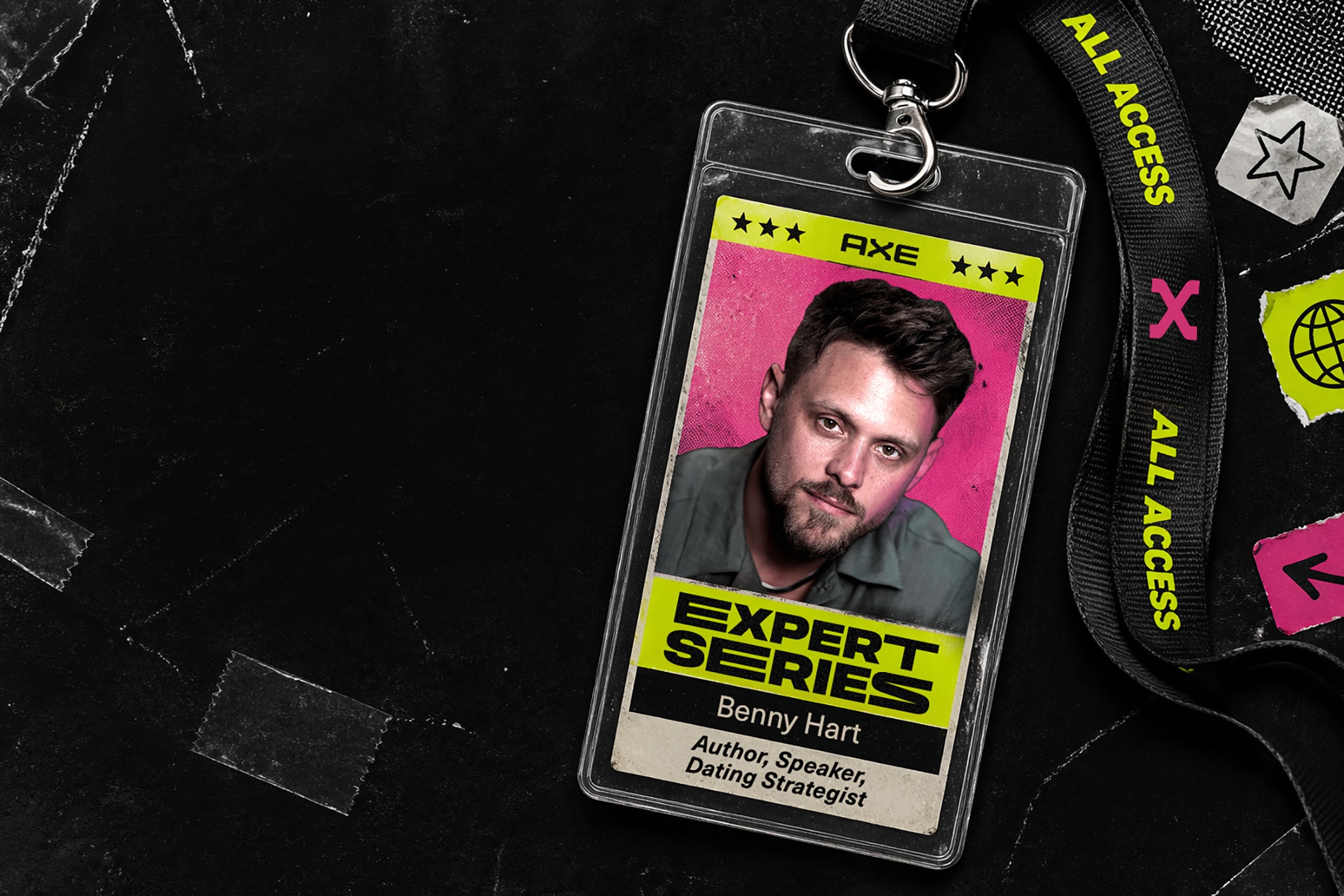
At AXE, we believe confidence starts with feeling good in your own skin. Sometimes that’s a great conversation. Sometimes it’s knowing you smell amazing walking into the room. For young guys, that extra boost of confidence can make group hangs feel a whole lot easier. That’s why we partnered with Ben 'Benny' Hart to unpack the confidence rules that help young men show up more naturally around other people.
A New York City–based multi-hyphenate entrepreneur, author, speaker, and dating strategist known for his raw, humorous, and no-nonsense take on both business and human connection, Benny has nearly one million followers across TikTok and Instagram. He’s built a reputation as one of the most authentic voices in relationships and personal development, blending street-level realism with boardroom credibility. Through his book “The Zero Mindset” and global speaking engagements, Benny combines mindset, self-awareness, and straight-up honesty to help people show up as their best selves.
____________________________________________________
Confidence looks different when you're out with friends versus when you're doing things on your own. When you’re in a group setting, you might find yourself feeling hyper-aware or hypersensitive. This means that you might be overly observant of yourself, hesitating because you're constantly thinking about how others are seeing you. And then you start to overthink.
Here's what to do about it.
Here's the thing: with some groups, there's familiarity. There's social proof. You know somebody who knows somebody who knows you. It feels safe. There's already a preconceived notion of who you are, and a preconceived identity. It may feel safer because you don't have to define your role from scratch.
That's really the key difference between being in a group and going out on your own. In a group, you have a shared identity, so there's a lot less pressure on you individually. But solo? Your identity is much more exposed. There's more pressure to prove yourself.
Here are some subtle cues that are important to read in a group:
When somebody's speaking in a group, who are they making eye contact with mostly? Who are they looking for approval from? Who do they want to agree with them? That tells you a lot about the power dynamic in the room.
Pay attention to who cuts people off and who naturally commands the floor. This reveals the social hierarchy within the group.
Read the energy of the people and the individuals. Is it high? Low? Fun? Tense?
This is an interesting one, because it doesn't necessarily mean they're introverted. It might just mean they're highly observant and taking a lot in rather than pushing a lot out.
As for knowing when to speak—especially in group dynamics—speak when you can add something to the table: an opinion, a relevant experience, or a story of your own. People love stories. They’re one of the best ways to get people genuinely interested in what you have to say.
Most guys perform in group settings because they're chasing significance. They want to prove they have enough value to add to the pot; like if they don't contribute something, what are they even doing there? They're performing for validation because significance matters to them. On the flip side, there's the fear of invisibility. Many hate feeling invisible, so they overcorrect and perform even harder. Both scenarios come from the same need of feeling significant.

Slow down: Don't speed up or try to over-assert yourself. Slow your speech, slow your movements. People don't necessarily pay the most attention to the loudest person in the room. They pay attention to someone saying something interesting. And often, the slower, more careful and considered person has the most impact.
Focus on one person, not the whole group: I've had to learn this myself through speaking engagements. I used to focus on the entire room, and it would distract me because I'd start thinking about how everyone was seeing me all at once. What actually works is focusing on one person and having that conversation with them. You can still look around, but anchor yourself to one person at a time. It helps you feel like you're in one conversation instead of ten.

You can always create a commonality out of nothing. Same shoes, same bag, same neighborhood. Commonalities are great icebreakers"
Contribute, don't try to impress: When you're performing to impress, people feel it. But when you're genuinely adding value or contributing, that comes across completely differently.
Confident body language is open. You're facing the group, not closed off in a corner. Your arms aren't crossed. Your movements are slow, composed and intentional.
Hand gestures are fine but crossed arms signal that you're closed off or reserved. Fast movements—especially ones that are close to people—can read as nervous or aggressive.
Slow it down, stay open, and let your body communicate the same calm you want people to feel from you."
In a group, you don't want to take over the stage. Leave room for people to talk. They notice when you call on them, ask them a question, make them feel seen and heard. That's actually what gives the group more energy and power.
When somebody dominates the whole time, people start to feel it. They might think: “This guy is doing too much. He's not asking any questions. He's just ranting.” So keep it short, contribute intentionally, and ask direct questions.
The goal of a group isn't your goal alone. The goal of a group is bonding. People feeling heard, learning from one another. And ironically, when you ask someone a question or give them space to speak, they feel more comfortable around you because you’ve shown enough confidence to hand them the floor.
People gravitate toward you not because you demanded their attention, but because you made them feel comfortable."
This might be the most important one. Don't over-assert yourself or try to prove yourself too much. When you don't volunteer everything about yourself, you become more interesting. People want to learn more about you when you haven't given them everything upfront. Mystery = confidence.
You don't always have to say something significant to show you're present. A nod, a smile, a good question, a confirmation. Those small reactions let people know you're locked in and paying attention.
Slow your speech, slow your movements. Composed and intentional always reads as more confident than fast and reactive. You don't need to fill every silence or jump into every gap. The most impactful people in the room are usually the most measured ones.
Confidence in group settings isn't about being the loudest, the funniest, or the most impressive person in the room. It's about being present, being open, and making the people around you feel seen and heard. People gravitate toward you not because you demanded their attention, but because you made them feel comfortable. That's what real confidence looks like. And the good news is, it's a skill you can build.
When the vibes are vibing, your scent combo can seriously carry your confidence. Think of your body wash as the base layer. Fresh, clean, setting the tone. And your deodorant as the signature finish that sticks with you all night. Pair something warm and slightly sweet with a bold, fresh scent, and suddenly you’re not just showing up, you’re making an entrance. AXE fine fragrances are designed to layer effortlessly, so you can find a combo that feels like you, just dialed up.
Whether you’re at dinner, a party, or “casual drinks” that turn into a whole night out, the right scent combo helps you own your space.
RELATED ARTICLES