
SAVE ON THE AXE FINE FRAGRANCE
COLLECTION
Join our Community and Discover the Axe Effect

Join our Community and Discover the Axe Effect
Save by signing up to receive communications from Axe and other Unilever Brands about exclusive offers, product updates, and more! By signing up, you agree to our Sign-Up and Save Policy and our Privacy Notice.
The holidays promise magic. Twinkly lights, cozy vibes, peppermint everything. But if we’re honest, December is basically a group project no one signed up for. It’s the “most wonderful time of the year,” burdened with financial panic, forced socializing, family tension, and the emotional whiplash of trying to stay cheerful while your bank account is screaming.
So, AXE did what any curious, culture-obsessed brand would do: we dug into the data. Using seasonal search trends across Gen Z and Millennials, we uncovered the eight biggest holiday stressors.
Here’s what the numbers had to say:
#1 Financial Anxiety – 84
#2 Social Anxiety – 72
#3 Travel Anxiety – 69
#4 Loneliness Anxiety – 67
#5 Post-Gift Purchase Anxiety – 63
#6 Family Anxiety – 57
#7 Mental Health Anxiety – 54
#8 Holiday Overwhelm – 53
What stresses you out most during the holidays? Take our quiz and see how your results compare to other AXE readers’…
Let’s unpack the biggest ones—what they mean, how they show up online, and what they reveal about modern life. Get comfy. It’s a holiday reality check.
Money isn’t just tight this year—it’s the main character. According to the AXE stress index, financial anxiety ranked #1 across the board, beating every other holiday pressure by a mile. Because between Black Friday blowouts and Secret Santa panic, money stress is the new mistletoe—unavoidable.
And search data backs it up:
And then there’s the big one: reputational risk. 38% of searches include fear of being seen struggling. Financial stress isn’t just private anymore—it’s public. And people feel watched.
“Money and financial anxiety are so common this time of year, but unfortunately for many, it goes unspoken,” says therapist and content creator Dr. Justin Puder. “Shame dissolves through connection and validation. Often, what we need is to connect with others and speak our anxiety out loud. We learn through these experiences that we are not alone and we don’t have to hide ourselves.”
And his advice for dealing with gifting pressure? “Setting a realistic budget or utilizing cooking and crafting are thoughtful ways to manage gifting through the holiday season. Most people will remember the connection you made with them over the things you bought.”
The holidays are supposed to be about connection, but for many, December is when socializing becomes a high-stakes performance review. Social anxiety comes in at #2 on the stress index, rising sharply from mid-November to Christmas as invites, reunions, and group photos pile up.
“From work parties to group dinners, December is introvert hell disguised as holiday cheer.
Searches reveal the overwhelm: “social battery low,” “masking,” and “party overstimulation” are up 300–500% YoY. 62% of queries include public embarrassment fears, including “How not to embarrass myself drunk”, “Everyone’s looking at me,” and “Boss will be there”. 41% reference reputation worries—being seen as awkward, weird, or “off.”
People are also looking for coping tools. There’s a 55% uplift in searches for:
The trend line doesn’t lie: social-anxiety searches peak Dec 15–24, up 320% over five years. Socializing isn’t getting easier—it’s getting heavier.
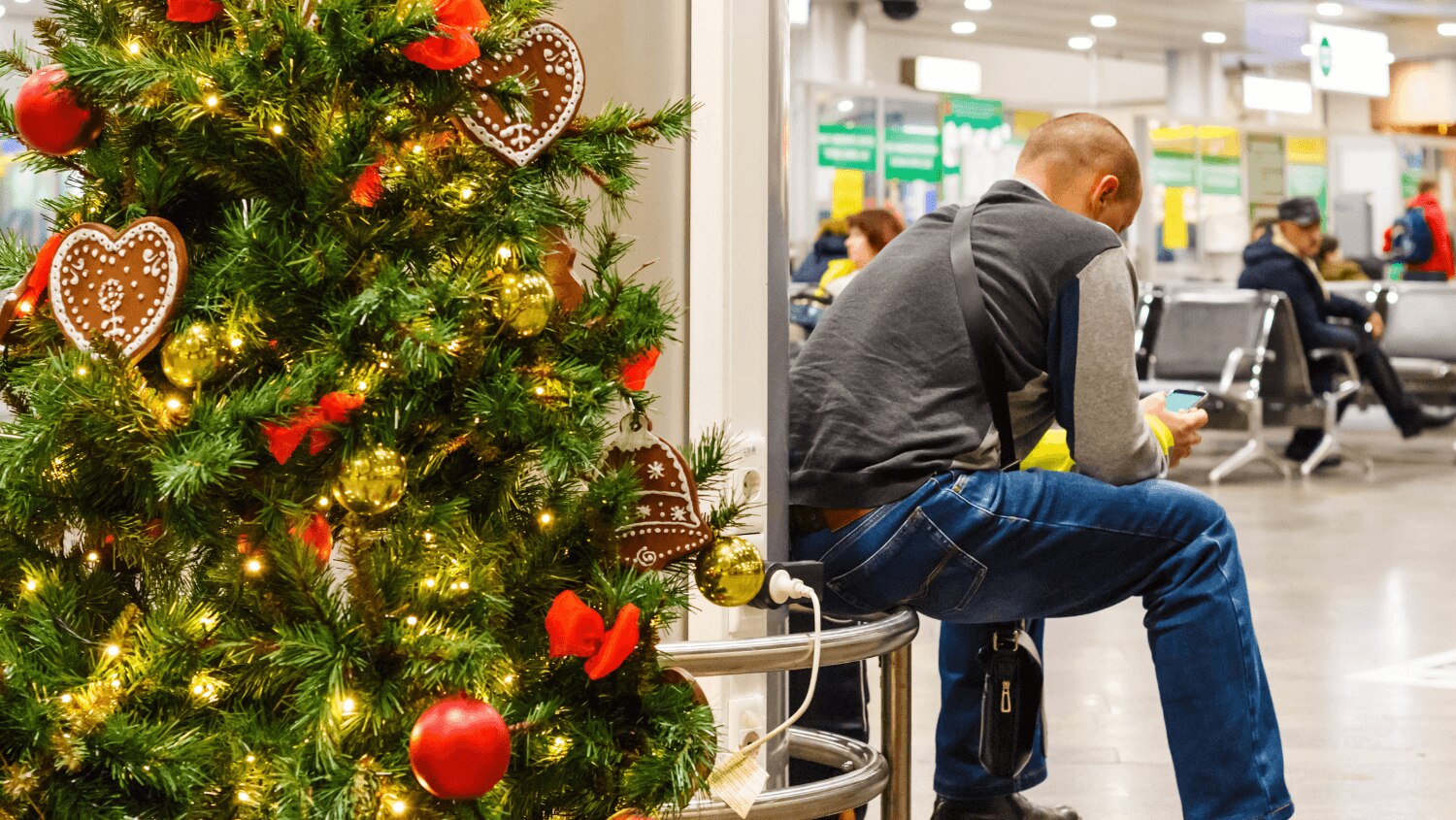
Getting home for the holidays isn’t a trip—it’s an emotional triathlon. And the data agrees. Travel anxiety ranks #3 overall, with some of the highest spikes around Thanksgiving and end-of-December return travel.
Every year, search behavior paints the same picture: chaos, tears, and a collective sense of “Why is everyone at this airport right now?”
The triggers light up nationwide. Strongest spikes show up in TX, CA, FL, NY, IL, and GA, but no state is safe.
Searches for
…are up 70%.
Travel-stress phrases rise 150% above baseline around Thanksgiving and Christmas Eve.
57% of queries include panic-related worries:
Searches like “Missed flight help,” “Delay compensation how now,” and “Panic attack on plane emergency tips” jump 170%.
And with family tension built in, half of all searches link travel directly to fear of conflict. “Will my family cut me off?” and “Ruin Christmas forever?”
Holiday travel is no longer a commute—it’s an emotional pressure cooker.
Loneliness isn’t loud—but it spikes every December, year after year. It’s the stressor people don’t talk about, but the search data does. And it ranks #4 overall, driven by comparison culture, complicated families, and the pressure to be cheerful when you don’t feel it.
It’s the only time of year you can feel both left out and overstimulated at once.
“Lonely at Christmas” surges every year for five straight years, peaking Dec 24–26—right when family photos start flooding social feeds. And family estrangement searches are rising, with searches like “No contact Christmas” and “Estranged from family” up 200%.
“Narcissistic parent” storytelling spikes 230%, as people unpack family dynamics in real-time—and look for ways to cope with the emotional load.
According to Dr. Puder, this is exactly why self-awareness and self-compassion matter most in December:
“It’s critical to pay attention to our body, emotions, and energy during the holidays, so we don’t burn out. When you need to recharge or set a boundary, try using a key phrase like: ‘I’d love to spend time with you, but my body is telling me I need to rest. Let’s find another time to connect so I’m at full capacity to enjoy your company.’ The key is to name how you’re feeling and express interest in spending time together in the future—if that’s your desire.”
His advice aligns with the data: people aren’t just searching for explanations—they’re searching for permission to protect their peace.
More than 56% of loneliness-adjacent searches mention fear of:
Examples include “How to avoid fight at dinner” and “What to say in front of whole family”.
Social comparison hits hard with 39% of searches including comparison-based thoughts like “Everyone’s together but me,” and “Why wasn’t I invited?” At the same time, searches show a rise in people creating their own sense of belonging. Terms like “Found family POV” and “No invite Christmas” are up 190%, reflecting a cultural shift toward redefining what it means to feel “at home.”
Here’s the plot twist: holiday stress isn’t a personal failure—it’s a perfectly human response to a month that demands emotional agility, financial strategy, and Oscar-worthy social performance. But you can make December feel less like a test and more like a choice.
Here are a few grounded principles that anyone can use to dial down the chaos:
You can’t do everything, and you’re not supposed to. Choose three things you genuinely care about this season (a person, an experience, a tradition) and let the rest fall into “optional.”
Money stress hits the hardest when it drags your self-worth into the equation. Decide how you want to feel during the holidays—calm, connected, less stretched—and let that guide your spending, not the other way around.
Parties, travel, family time. All of it is easier when you build in micro-recharge moments. Think: a 10–minute walk, a quiet corner, a breathing break, a “step outside before the meltdown hits” strategy. Emotional regulation works better when it’s planned, not improvised.
If your holiday doesn’t look like the movies, you’re not doing it wrong. You’re doing it honestly. Found family, quiet traditions, solo rituals, digital hangouts… all count. Connection doesn’t have to be traditional to be real.
Not every invite must be accepted. Not every tradition needs repeating. Not every conversation deserves your mental energy. Boundaries aren’t anti-holiday; they’re how you protect yourself and honor your needs.
If there’s one takeaway from the AXE data, it’s this:
With intention, a bit of self-awareness, and permission to do December your way, the season becomes less performative and more personal.
RELATED ARTICLES